




New billing for video calls running via servers
Video calls that go via Voximplant servers (not P2P ones) are billed per megabyte of video traffic.
 2016-12-14
 129534
Video calls that go via Voximplant servers (not P2P ones) are billed per megabyte of video traffic.
2016-12-14129534
Blind transfer is when a person who transfers the call won't talk with the person to whom he transfers it.
2016-12-07132565
We are happy to announce the high quality speech recognition for both audio call records transcription and real-time recognition scenarios.
2016-11-11144194
The new version of Web SDK will help us to accelerate the development process and includes a lot of new features and improvements.
2016-09-29135395
Now developers can use Promise in their VoxEngine scenarios and we also added Net.httpRequestAsync and Net.sendMailAsync functions.
2016-07-07132808
Your mp3 or ogg files played on VoxEngine scenario level with call.startPlayback or using Player will be played on the Web or Mobile SDK side in HD quality (48KHz), or on SIP side if it does support wideband audio codecs (Speex or Opus).
2016-04-06137283
In HD mode audio is being mixed at 48KHz, all audio sources with lower sample rate will be resampled to 48KHz.
2016-03-29132259
We chose 48 KHz as the base sample rate for HD audio recorder, since WebRTC/Opus can offer this quality, audio from endpoints with lower sample rate will be re-sampled.
2016-02-04138746
Full Featured Instant Messaging
2016-01-02132390
If a call is made in non-P2P mode then its media stream goes via our media servers and we can record it if required.
2015-12-01134106
We've started with audio, then we've added video calls and now it's time to let our developers use instant messaging and presence - two very important features of UC stack.
2015-05-14128570
The new version of our mobile SDK uses WebRTC engine for audio/video processing and supports all features available for WebSDK.
2015-03-25135031

The new integration enables instant connection of any Voximplant call to an Ultravox agent, delivering seamless voice-to-voice conversations.
2025-05-2826424
Voximplant AI Agent Skills let your coding agent build and ship voice applications without switching tools
2026-06-11146
Voximplant has new realtime speech generation for voice AI from Inworld, our latest Voice AI text-to-speech (TTS) partner. Together, we combine state-of-the-art TTS with carrier-grade connectivity so you can build voice agents that sound like your brand, not a generic robot.
2025-12-0812484
New integrations for Voice AI have arrived: Google's Gemini 2.0 Flash model, featuring seamless voice-to-voice conversation capabilities and ElevenLabs low-latency streaming speech synthesis are now available for Voximplant developers
2025-03-3185974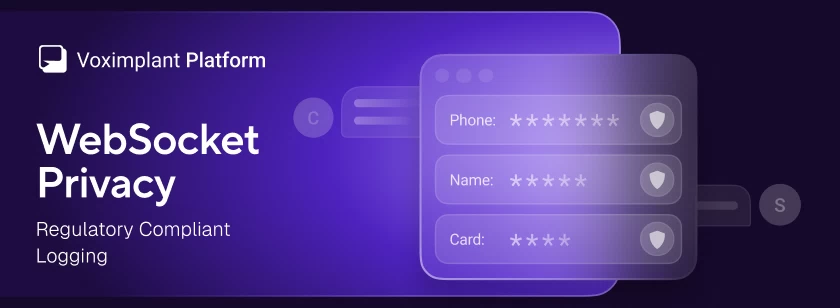
Voximplant has added a WebSocket privacy option that redacts message payloads from logs across all WebSocket-based services – Voice AI connectors and external speech system – and speech control modules
2026-04-23972
Voximplant now lets developers build full-cascade voice AI pipelines in VoxEngine without sacrificing turn-taking quality.
2026-03-262792
Voximplant now includes a native Cartesia module for streaming, low-latency text-to-speech (TTS). You can use a single VoxEngine API to synthesize speech in real time, connect it to any call (PSTN, SIP, WebRTC, WhatsApp) and control playback from a Large Language Model (LLM) or other source, all inside VoxEngine.
2025-11-187725
Today Ultravox announced they are directly integrating Voximplant into their platform to provide SIP capabilities. The integration builds on Voximplant’s deep telephony and Voice AI tooling
2025-10-296446