




Choose Between Inbound and Outbound Call Center
This article aims to outline the differences between inbound and outbound call centers. Read on if you are trying to decide which type of call center is best for your business.
 2020-07-28
 74501
74501This article aims to outline the differences between inbound and outbound call centers. Read on if you are trying to decide which type of call center is best for your business.
2020-07-2874501
Call center automation utilizes your resources more efficiently while also providing better customer service
2020-01-06181644

Voximplant now includes a native Grok module that connects any Voximplant call to xAI’s Grok Voice Agent API for real-time, speech-to-speech conversations. With a single VoxEngine scenario, you can interact via audio with Grok over phone numbers, SIP trunks and infrastructure, WhatsApp Business, or WebRTC into Grok — all without building custom media gateways or WebSocket streaming infrastructure.
2026-01-1412052
New integrations for Voice AI have arrived: Google's Gemini 2.0 Flash model, featuring seamless voice-to-voice conversation capabilities and ElevenLabs low-latency streaming speech synthesis are now available for Voximplant developers
2025-03-3185931
Voximplant now includes a native Cartesia Line / Agents connector that connects any Voximplant call to a Cartesia Line voice agent for real-time, speech-to-speech conversations—over PSTN, SIP, WebRTC, or WhatsApp Business Calling—without building custom media gateways or WebSocket streaming infrastructure.
2026-02-116524
Check out the latest useful Voximplant Kit updates — we developed chat analytics, improved call history, added new tools for supervisors, expanded scenario capabilities, and updated the softphone. Below is a brief overview of the essential enhancements.
2025-05-1531758
Voximplant now includes a native MCP Client for VoxEngine, giving developers direct connectivity to any MCP server and full control over every tool call
2026-06-03271
Voximplant now lets developers build full-cascade voice AI pipelines in VoxEngine without sacrificing turn-taking quality.
2026-03-262761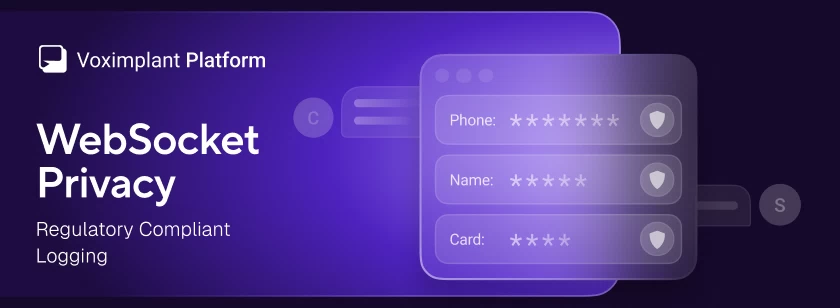
Voximplant has added a WebSocket privacy option that redacts message payloads from logs across all WebSocket-based services – Voice AI connectors and external speech system – and speech control modules
2026-04-23943
Voximplant has new realtime speech generation for voice AI from Inworld, our latest Voice AI text-to-speech (TTS) partner. Together, we combine state-of-the-art TTS with carrier-grade connectivity so you can build voice agents that sound like your brand, not a generic robot.
2025-12-0812412