




Cloud-side JavaScript "Promise" handling update
Make sure to use "catch" method on promises!
 2018-07-03
 130725
Make sure to use "catch" method on promises!
2018-07-03130725
HD Text-to-Speech from Google powered by WaveNet is now available to all our developers.
2018-05-07129246
Starting on April 25 we change our callPSTN API: “caller id” is no longer optional and must be specified.
2018-04-04226552
To make our platform better we are now removing the limit, so URL length can be longer than 255 characters.
2018-03-30222166
Voximplant now can save audio without compression.
2018-03-15226724
Both our cloud JavaScript engine and Web JavaScript editor now support modern JavaScript syntax.
2017-10-16130721
The latest version of our Web SDK is fully compatible with the new Safari 11 audio/video calls support.
2017-09-21131707
A brand-new messaging API was added across Web, Android and iOS SDK.
2017-08-17148945
Following Google’s release of new Speech API, we are happy to announce improved quality of call records transcription.
2017-08-14134657
We are happy to announce that video calls that use H.264 video codec can now be recorded. Recorded video calls that use H.264 will be stored as mp4 files (calls with video in VP8 format are stored as webm files).
2017-05-02133278
Now Unity developers can use the SDK to embed real-time voice and video communication into VR/AR apps and games in minutes, we will take care of complexity and infrastructure.
2017-04-17127626
Voximplant now supports VoIP Push Notifications for calls to iOS SDK.
2016-12-28133865

Voximplant now includes a native Cartesia module for streaming, low-latency text-to-speech (TTS). You can use a single VoxEngine API to synthesize speech in real time, connect it to any call (PSTN, SIP, WebRTC, WhatsApp) and control playback from a Large Language Model (LLM) or other source, all inside VoxEngine.
2025-11-187808
OpenAI has recently announced GA version of their Realtime API that Voximplant now fully supports
2025-10-1024334
The new integration enables instant connection of any Voximplant call to an Ultravox agent, delivering seamless voice-to-voice conversations.
2025-05-2826445
Voximplant now includes a native Cartesia Line / Agents connector that connects any Voximplant call to a Cartesia Line voice agent for real-time, speech-to-speech conversations—over PSTN, SIP, WebRTC, or WhatsApp Business Calling—without building custom media gateways or WebSocket streaming infrastructure.
2026-02-116595
Connect any Voximplant call to ElevenLabs Conversational AI agents
2025-06-0925804
Voximplant has new realtime speech generation for voice AI from Inworld, our latest Voice AI text-to-speech (TTS) partner. Together, we combine state-of-the-art TTS with carrier-grade connectivity so you can build voice agents that sound like your brand, not a generic robot.
2025-12-0812550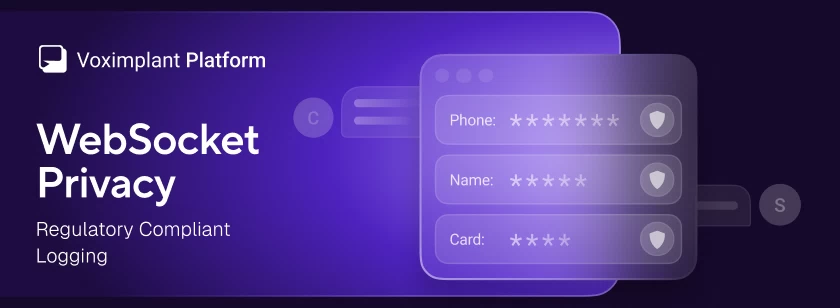
Voximplant has added a WebSocket privacy option that redacts message payloads from logs across all WebSocket-based services – Voice AI connectors and external speech system – and speech control modules
2026-04-23996
Voximplant now lets developers build full-cascade voice AI pipelines in VoxEngine without sacrificing turn-taking quality.
2026-03-262826