




Smartcalls at Web Summit 2018 (Lisbon)
How we presented our visual tool for call automation at one of the largest annual technology conference.
 2018-11-20
 185772
How we presented our visual tool for call automation at one of the largest annual technology conference.
2018-11-20185772

OpenAI has recently announced GA version of their Realtime API that Voximplant now fully supports
2025-10-1024152
New integrations for Voice AI have arrived: Google's Gemini 2.0 Flash model, featuring seamless voice-to-voice conversation capabilities and ElevenLabs low-latency streaming speech synthesis are now available for Voximplant developers
2025-03-3185978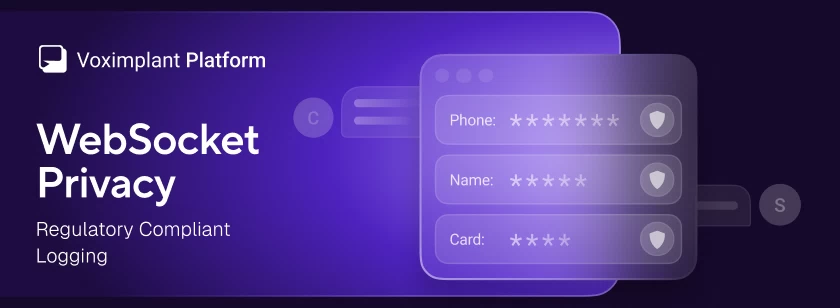
Voximplant has added a WebSocket privacy option that redacts message payloads from logs across all WebSocket-based services – Voice AI connectors and external speech system – and speech control modules
2026-04-23972
Voximplant has added Secrets, a dedicated credential store for API keys, tokens, and other sensitive values that VoxEngine scenarios need at runtime
2026-04-27969
Voximplant now supports Inworld's Realtime API, so you can bring Inworld's expressive, conversation-aware agents into real phone calls, SIP, and WhatsApp without custom media infrastructure
2026-06-17127
Voximplant now lets developers build full-cascade voice AI pipelines in VoxEngine without sacrificing turn-taking quality.
2026-03-262793
Voximplant has new realtime speech generation for voice AI from Inworld, our latest Voice AI text-to-speech (TTS) partner. Together, we combine state-of-the-art TTS with carrier-grade connectivity so you can build voice agents that sound like your brand, not a generic robot.
2025-12-0812486
Voximplant now includes a native Deepgram module that connects any Voximplant call to Deepgram’s Voice Agent API for real-time, speech‑to‑speech conversations. You can stream audio from phone numbers, SIP trunks, WhatsApp, or WebRTC into Deepgram’s unified agent environment—combining STT, LLM reasoning, and TTS—and play responses via Voximplant’s serverless runtime with minimal latency.
2025-12-178926