




Improve Transcription and Leverage Advanced features with Google Speech Beta Features
Voximplant has released an option for enabling Google Cloud Speech-to-Text (STT) Beta features.
 2020-09-24
 150091
Voximplant has released an option for enabling Google Cloud Speech-to-Text (STT) Beta features.
2020-09-24150091
Move faster, serve customers everywhere, without requiring a single line of code
2020-09-14159995
When a business grows and faces the need to automate sales processes and improve customer interaction, choosing the right CRM system becomes an important task. Today, we are going to talk about cloud-based and on-premise CRMs. Which type is right for your business? Let’s find out.
2020-09-08203934
What the bots learned in five years
2019-11-12187496
With speech synthesis support for Microsoft Azure Text-to-Speech, you can choose from more than 425 voice options covering 40 languages and 60 dialects from 6 distinct speech synthesis engine providers.
2020-09-01162107
Flutter is a new mobile application development environment that arrived on the scene in early 2019 and has attracted a lot of attention.
2020-09-01158815
It’s time to set the record straight about fixed vs non-fixed VoIP phone numbers
2020-09-01159679
The SIP protocol supports transport over TCP and UDP with each having its advantages and disadvantages. In addition, security considerations may drive you to consider the TLS protocol
2020-08-24181688
Voximplant has a dedicated A2P (Application to Person) SMS API for high-volume messaging needs.
2020-08-20186822
Customers are now much better informed than ever before and there are so many products, services and solutions that users can choose from. If you do not offer them what they want and are looking for, you can easily lose customers.
2020-06-29155166
Sending an SMS message from Python is simple. Using the Voximplant platform, you just need to setup some credentials, pick a phone number, and use a simple API command
2020-08-04168168
We recently added IBM Watson™ Text-to-Speech to our list of speech synthesis engine options, expanding the number of voices you dynamically synthesize as part of phone and web calls.
2020-07-28192129

Connect any Voximplant call to ElevenLabs Conversational AI agents
2025-06-0925687
New integrations for Voice AI have arrived: Google's Gemini 2.0 Flash model, featuring seamless voice-to-voice conversation capabilities and ElevenLabs low-latency streaming speech synthesis are now available for Voximplant developers
2025-03-3185957
Voximplant has new realtime speech generation for voice AI from Inworld, our latest Voice AI text-to-speech (TTS) partner. Together, we combine state-of-the-art TTS with carrier-grade connectivity so you can build voice agents that sound like your brand, not a generic robot.
2025-12-0812451
The new integration enables instant connection of any Voximplant call to an Ultravox agent, delivering seamless voice-to-voice conversations.
2025-05-2826412
Voximplant now includes a native Cartesia module for streaming, low-latency text-to-speech (TTS). You can use a single VoxEngine API to synthesize speech in real time, connect it to any call (PSTN, SIP, WebRTC, WhatsApp) and control playback from a Large Language Model (LLM) or other source, all inside VoxEngine.
2025-11-187667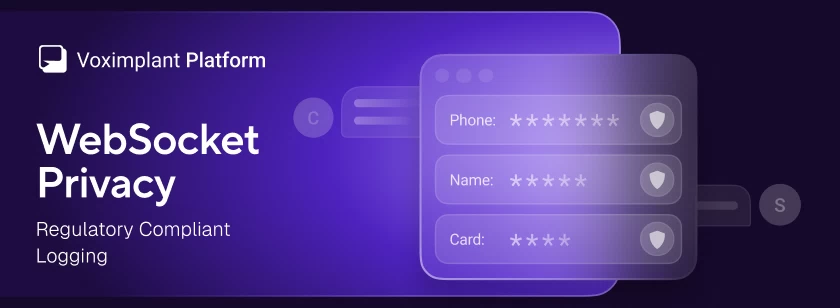
Voximplant has added a WebSocket privacy option that redacts message payloads from logs across all WebSocket-based services – Voice AI connectors and external speech system – and speech control modules
2026-04-23961
Voximplant now includes a native Cartesia Line / Agents connector that connects any Voximplant call to a Cartesia Line voice agent for real-time, speech-to-speech conversations—over PSTN, SIP, WebRTC, or WhatsApp Business Calling—without building custom media gateways or WebSocket streaming infrastructure.
2026-02-116546
Voximplant now includes a native Grok module that connects any Voximplant call to xAI’s Grok Voice Agent API for real-time, speech-to-speech conversations. With a single VoxEngine scenario, you can interact via audio with Grok over phone numbers, SIP trunks and infrastructure, WhatsApp Business, or WebRTC into Grok — all without building custom media gateways or WebSocket streaming infrastructure.
2026-01-1412115